

As I was working out a topic for this week’s post, I came across this one from May 6, 2014. Reading it, I am reminded that once more my memoir has thrown me a curve ball. I need to sort out what to do with this draft still waiting in the corner.
The two curve balls came from different directions and for different reasons. If you want to know more about the second curve ball, you can read a personal note to my followers and friends who subscribe to my newsletter.
Upon reflection, I believe my May 6, 2014 post may stand me in good stead when the time is right to begin inching my hands toward the binder holding my manuscript. I don’t think I’ll be rewriting so much as restructuring and moving things in my draft around to make my memoir more readable. The wheels are turning and never forgetting this draft, but the pull to go back and revisit this post left me with a need to share it with you once again.
Here’s the original post from May 6, 2014:
WHAT TO DO WHEN THE BOOK YOU’RE WRITING THROWS YOU A CURVE BALL
The drafting of my memoir began in earnest sometime the late spring of 2012. I had jotted down notes and memories plus digging through boxes of my mother’s personal papers for years. Folders filled with potential material for a book cover a work table.


Now, here we are approaching late spring of 2014, two years later. A few weeks ago as I was considering my progress and listening to my husband’s take on what I had written for one particular chapter, I felt like I had been hit by a tidal wave of emotion.
It was as if a tsunami had taken over the life of my memoir, and what came next threw me for a curve.
An epiphany in the form of a major change in direction left me wonder struck. Not so much because it was such a stunning transformation, but because it had stared me in the eye since the year 2000, when the seed germinated into thoughts of a memoir after moving my mother to Oregon from Tennessee.
Now, what am I going to do was the next thought passing not so silently through my mind. It was simple: Regroup, rethink, rewrite–the writer’s three R’s.
REGROUP:
When I began writing my story of life with Mama, I sat down and started pounding out words on the computer screen without any thought for an outline or a plan. I knew the story I was writing and thought I needed no organizational scheme to get it done. So far, I believe I have a pretty good draft on that first turn. But this curve ball I’ve been thrown made me stop and take stock of the time I would have saved if I had gotten my writing act together first.
- The first thing I decided I needed to do was spell out what I wanted to tell my readers and why. And I did.
- I then moved on to think about outlining or story boarding. I vaguely remembered a post of Kathy Pooler’s on Memoir Writer’s Journey where Kathy talked about story boarding. Unable to find it, I emailed Kathy and she sent me the link, which is here.

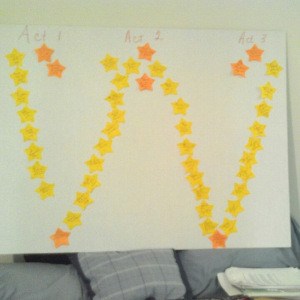
- As I sat and studied Kathy’s storyboard, it occurred to me that my favorite writing software, Scrivener, uses a bulletin board with index cards to act as an option to an outline. I rarely use it, but checked it out and below is an image of my current storyboard or imaged outline in Scrivener:


- I think it’s going to work perfectly, and I’ve set about rewriting my first draft.
RETHINK
A good deal of rethinking went into picking up the draft and rewriting it. Was this worth making the book into a better story to share with readers? Would the rewrite get my point across any better? After all, I’d spent a goodly number of hours not only in writing but researching, retrieving and reading.
- I decided the answer was a yes. I want to publish not just a good book, but a book people will refer to as a “really good book,” perhaps a “must read,” maybe even a “bestseller.” No matter the nomenclature used to describe it, I want it to be my best work product. So, yes, the extra time is worth the effort.
- As I rethought the outline I’d come up with it, I could actually see the story unfolding in a much more cohesive fashion and with greater ease.
- Rethinking taught me a great lesson: Rushing in headlong isn’t always the best route to take.
REWRITE
I am actually enjoying this “R” of the three “R’s” because I am sensing a better writing style, a tighter style. I feel the story coming together with less negativity about my mother, seasoned with a dash of her goodness here and there, because there was goodness in her. And at the end of her story and mine, I learn there was good reason for her parenting skills, or lack thereof. I think in the rewrite this will be more easily finessed.
Like schoolchildren sent off to learn their three “R’s”–reading, writing and ‘rithmetic, we writers can also learn from a different set of three “R’s”–regroup, rethink and rewrite.
We’re never too young or too far along in our writing to learn a little something or make a change in the direction we’re headed.
Happy writing!